


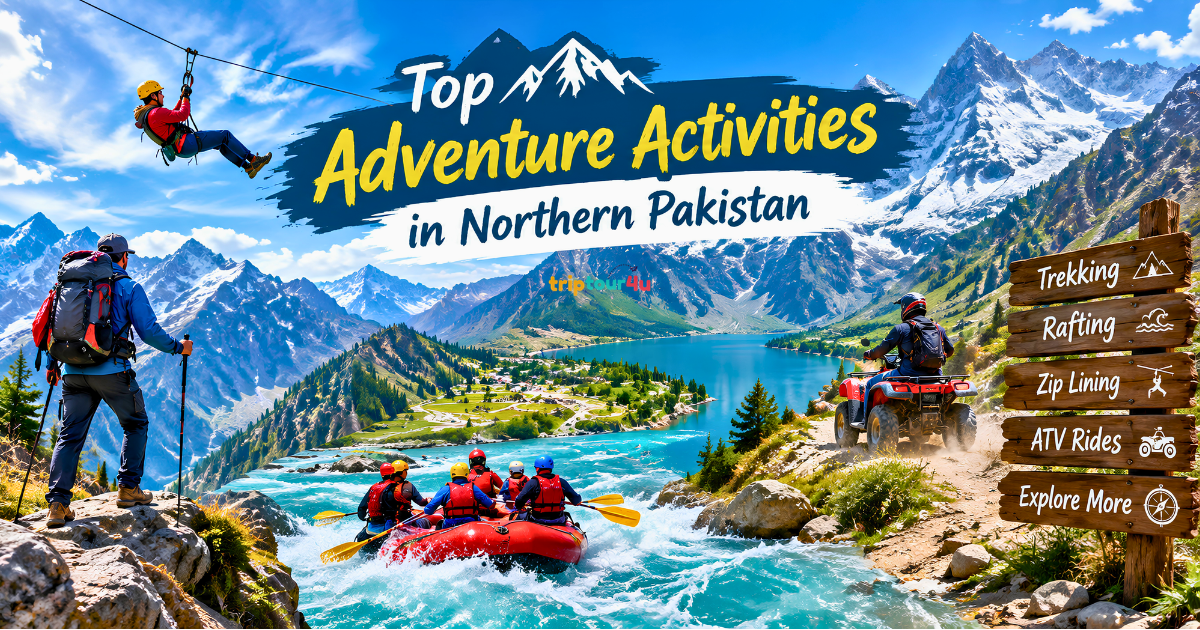
Top Adventure Activities in Northern Pakistan
Northern Pakistan remains one of the world’s last frontiers in adventure travel. Three of the most powerful mountain ranges in the world—the Karakoram, the Himalaya, and the Hindu Kush—are physically colliding here, all packed together into an area smaller than England. K2 (8,611 m), the second-highest and most technical mountain in the world, is located here. The Deosai Plateau, the world’s 2nd highest plateau, the enchanting valleys of Hunza and Skardu, the glacier system larger than the Alps, and the rivers fed by melting ice make up a vast natural adventure park spanning many thousands of square kilometers.
The guide includes information on all major activities in the North, including trekking, mountaineering, and jeep safaris. It also covers white-water and river rafting as well as mountain biking and wildlife excursions.
Northern Pakistan is an adventure traveler’s dream.
Top Adventure Activities in Northern Pakistan
There are few destinations that combine such a vertical contrast with such a small tourist infrastructure. Gilgit-Baltistan covers 72,971 sq km and has more high peaks per square kilometer than any other comparable-sized area on earth. Five of the seventeen 8000 m world peaks rise from the valleys. The region’s fabric is woven together beyond the giants. Karakoram Highway (KKH): the highest international road in history, with turquoise lakes and glacier valleys. Villages where the hospitality of their people is a duty.
The emptiness is what makes this place so different from the Himalayas of Nepal or the Alps. You’ll often go for days on a trek without ever seeing another trekker. Instead, you will walk with Balti and Wakhi porters in landscapes that are untouched by the Silk Road caravans.
1. Adventure Trekking in the Heart of Northern Pakistan
Top Adventure Activities in Northern Pakistan
The most popular activity for adventure seekers in the North is trekking. This can range from two-hour walks through meadows to a three-week expedition on ice.
Concordia Trek & K2 Base Camp
The most popular and iconic trek in Pakistan, this trek follows the Baltoro Glacier from Concordia to the highest peak of all, K2 (8.611 m), Broad Peak, and the Gasherbrums. Askole to Concordia is the classic route. Gondogoro La (5,585 m): For a more spectacular and technical departure towards Hushe—a trip that usually takes between 18 and 21 days from Islamabad. The Baltoro Glacier is a challenging route that requires excellent mountaineering and fitness.
Fairy Meadows & Nanga Parbat Base Camp Trek
Fairy Meadows offers the best high-altitude experiences in the North. It is a lush, alpine meadow located directly below Nanga Parbat (World’s Ninth Highest Peak) (8126 m), also known as “Killer Mountain.” The Fairy Meadows Trek near Nanga Parbat is suitable for beginners and takes just 2-3 hours. It has a gentle ascent with well-marked trails. It is ideal for those with little time and no trekking experience. After Fairy Meadows, you can continue for a 1-2-day trek to Nanga Parbat Base Camp, where you will get a close-up view of Rupal and the Diamir Faces.
Rakaposhi Base Camp Trek
The moderate 2-day trek from Hunza Valley to Rakaposhi (7.788m) is one of the best-photographed peaks of the Karakoram. It rises directly up the mountain without any high terrain in between.
Rush Lake Trek
The 5-day journey begins with a scenic drive through Hooper Valley, where you will meet the porters. You then trek along the Hooper Glacier past Laila Peak and the Hooper Glacier. Rush Lake, located at the top of Mount Rush Lake in the alpine region, is accessible to anyone without climbing equipment.
Biafo-Hispar Glacier Traverse (“Snow Lake”)
This is one of the longest glacier systems in the world outside the polar regions. The 15-19-day expedition traverses the vast snow lake icefield from Askole via Hispar La (5151 m).
There are many other interesting treks.
- >Passu Glacier Trek
- >Shimshal Valley Treks—including Chipchingol Pass (also known as the Pamir Pass), Shimshal Pass (also known as the Shimshal Pass), and the remote Lukpe La Route.
- >Mazeno Pass Trek—a challenging 22-day circular route around Nanga Parbat’s western flank.
- >Ghilam Harish Trek—a less-known route that takes you through the picturesque Yasin Valley.
- >Deosai Crossing—a multiday trek/jeep combo across the high plateau, between Skardu & Astore.
2. Mountaineering the Karakoram
Top Adventure Activities in Northern Pakistan
The Karakoram is a paradise for serious mountaineers. It has the largest concentration of extreme peaks anywhere on Earth. Climbers will find a variety of challenging peaks in the most spectacular landscapes on the planet, including Broad Peak, Gasherbrum, and Trango Towers.
The following are the key objectives of your expedition:
- >K2 (8,611 m)—the ultimate prize in mountaineering, more technically challenging and statistically dangerous than Everest.
- >Gasherbrum I & II (8,000 m / 8,035 m), the easier 8,000ers in the Karakoram.
- >Trango Towers—a group of granite spires that are considered to be among the world’s best rock climbing goals (and the hardest), attracting elite climbers and not trekkers.
- >Spantik, Diran, and Rakaposhi—popular “trekking peaks” in the 7,000 m area, which are often used for acclimatization before attempting 8,000 m.
A formal permit is required for all peaks over 6,500m, regardless of the zone. (See permits below). This must be arranged by a registered adventure operator and supported by Balti high-altitude porters. Many of these porters are from families that have climbed the Karakoram for generations.
3. Jeep Safaris & Off-Road Adventures
There are many ways to explore the North. Jeep safaris can be the only access to some of the remotest and most beautiful valleys.
- > Deosai Plateau Crossing—the dirt road from Skardu across to Astore on the plateau of “the Land of Giants” is typically open from late June to September. The route passes through brown bear habitats, glacial lakes, and wildflower meadows at 4,000 meters.
- >Shimshal Jeep Track is one of the most spectacular 4×4 tracks in the world. It clings to the cliff edge above the Shimshal River.
- >Khunjerab Pass Run—At 4,693 meters, this is the highest paved border crossing on the planet, connecting Pakistan to China’s Xinjiang Region via the Karakoram Highway. The drive from Sost passes snow-dusted peaks, yaks grazing, and Marco Polo Sheep occasionally spotted within the national park.
- >Chapursan and Broghil Valley safaris—remote Frontier Valleys near the Afghan Wakhan Corridor. Home to Wakhi Communities and Yak Herding Culture.
- >Kalash Valleys—Long Jeep journeys take you to the Kalash Valleys of Bumburet, Rumbur, and Birir. These valleys are home to Pakistan’s most distinctive indigenous group, which is known for its unique festivals and customs.
4. River Sports & White Water Rafting
The Karakoram Mountains and Himalayas feed several rivers that have strong rapids.
Indus River rapids range from class I to IV. They are suitable for both novices looking to enjoy a white water rafting experience and experienced adventurers who want an adrenaline rush. The dramatic Skardu Valley Gorge is the backdrop to many routes. The other prime rafting routes include the Kunhar River between Naran and Kaghan, the Panjkora River from Dir to Batkhela; the Indus River from Jaglot to Thakot; the Hunza River from Aliabad to Gilgit; and the Shyok River from Khaplu to Skardu. All of the rivers in Chitral, Gilgit, and Swat, as well as Hunza and Kunar, offer excellent opportunities for canoeing and kayaking.
The majority of commercial trips run half-day and full-day trips. A few multi-day trips combine rafting and riverside camping along with village visits on the Indus.
The best season is from June to August, when the snowmelt increases water levels. Note that this means rapids will be at their strongest.
5. Paragliding & Aerial Adventures
Top Adventure Activities in Northern Pakistan
Pilots launch from the ridgelines of Karimabad or Duikar and soar above the Hunza River, Rakaposhi, and Ultar Sar. Tandem flights for beginners are becoming more common, and there is also a growing number of solo pilots who explore thermals in Skardu or Naran-Kaghan.
The adventure of scenic flights is also included in this unusual manner: When the weather is right, you can see Nanga Parbat—the ninth-highest mountain in the world—up close. This is a truly bucket-list adventure, but it can be cancelled due to bad weather. Overland travel serves as a backup.
6. Mountain Biking & Cycling on the Karakoram Highway
It is one of the world’s most popular high-altitude biking routes. The Karakoram Highway, also known as the Eighth Wonder of the World, climbs from the Indus Plains in Besham, through Chilas and Gilgit, to the Khunjerab Pass on the Chinese border. The ride is done in phases over 1 to 3 weeks. Riders camp or stay in guesthouses on their way. Support vehicles carry gear along the more difficult stretches. Mountain-biking short day trips around Hunza’s village tracks are popular, as well as around Skardu’s river valleys.
7. Wildlife & High-Altitude Nature Adventures
Top Adventure Activities in Northern Pakistan
This remote location protects the rare animals and makes it a special place to trek. Wildlife photography is a popular activity in the region. You can see snow leopards and other wildlife, including Marco Polo sheep, Himalayan bears, Marco Polo sheep, and many bird species. Deosai National Park in Pakistan is one of the most popular places in Asia to see the Himalayan brown bear in its natural habitat, especially at dawn and dusk between June and August. Central Karakoram National Park and the high valleys surrounding Khunjerab are ideal, though difficult, territory for snow leopards. Sightings of the animals are very rare, but specialist tour operators are offering more and more tracking and camera trap tours.
8. Winter Adventure Sports
Winter offers a variety of adventure activities that are not available in summer.
- Malam Jabba—Pakistan’s oldest ski resort with groomed slopes and a chairlift.
- Naltar Valley, a small, remote ski area popular among freeriders and hosting occasional international competitions.
- Ice-climbing and winter trekking in Hunza or Naltar is for anyone looking to find quieter trails and frozen waterfalls.
The Best Time of Year to Enjoy Adventure Activities
Top Adventure Activities in Northern Pakistan
From May to October is the best time for adventure and trekking in Pakistan. The weather is ideal up north. The summer months offer ideal conditions for trekking at high altitudes. However, autumn is a great time to enjoy beautiful landscapes and fewer people. The best time to travel in the Karakoram is during summer, when conditions are at their peak.
The rough breakdown of the season:
The SeasonThe MonthsThe Best for
Spring March-May Hunza blossom season, lower-valley hikes, photography
Summer June-August High-altitude trekking, K2 Base Camp, Deosai crossing, rafting (peak snowmelt)
Autumn September-October Ideal trekking temperature, golden foliage, and quieter trails
Winter November-March Off-season culture, skiing, ice climbing, and other winter sports (many routes are closed).
Deosai’s one dirt road from Skardu towards Astore typically opens only from June to September. Plan your trip around this window if crossing the Deosai is something you want to do.
Restricted zones, regulations & permits
It is important to note that this section of the planning process can be confusing for some travelers.
First, the good news: the vast majority of Gilgit-Baltistan—including Hunza Valley, Skardu, Shigar Valley, Deosai National Park, and the Karakoram Highway—requires no special permit for foreigners. Arrive, show your passport at the routine checkpoints, and proceed.
The use of NOCs, or No Objection Certificates, becomes more relevant to a limited number of routes and border areas:
- High-altitude trekking permits: For major routes at high altitude, such as K2 Base Camp and Gondogoro La.
- Permits for mountaineering: All peaks over 6,500 meters need a Gilgit-Baltistan Council permit, whether they are in “open” zones or restricted areas. Applications must be submitted by an accredited tour operator along with all the required documentation. The GB Council does not require a trekking permit for “Open Areas.”
- Border/restricted zone NOCs: For Baltoro glacier routes, including the K2 Base Camp Approach and Concordia, certain valleys close to Afghanistan’s border and zones adjacent to the Line of Control.
- Khunjerab National Park permit: The park is open to all visitors, even those traveling towards the Khunjerab Pass.
- Deosai National Park Entry Permit: No advance documentation is required.
Booking high-altitude trekking and mountaineering objectives above 6,500 m through a licensed, registered Pakistani tour operator is the most convenient and reliable option. They will handle all paperwork for the GB Council, NOCs, and local authorities as part of their package. This removes the majority of administrative work from the traveler.
Visa Note: Pakistan has an eVisa system and an Electronic Travel Authorization System (ETA). Check current eligibility prior to booking, as visa policies are updated periodically.
Plan your trip and compare costs.
Top Adventure Activities in Northern Pakistan
The cost of a trip varies greatly depending on the length and size of your group, as well as whether or not you choose to book through an operator. As a guide, however:
- Short Treks (Fairy Meadows and Rakaposhi base camp): Typically bookable in 3-6-day packages, including guides, porters, and transport to Gilgit or Islamabad.
- Major Treks (K2 Base Camp/Concordia and Gondogoro La). Typically run for 18-21 days, including acclimatization; the cost reflects porter teams, cook staff, and camping gear.
- Expeditions to peaks between 7,000 and 8,000 meters: Among the most expensive adventures in the world once you factor in permits, porters at high altitudes, logistical support, equipment, etc. Expect quotes that are tailored for each expedition.
- Day Activities: Generally affordable compared to international adventure tourism pricing. Easy to book in Hunza or Skardu once you arrive.
In Pakistan, tipping is optional but appreciated. It is customary to give 10% for excellent service in restaurants, while smaller amounts are given for drivers, guides, and porters.
Travel Safety in Northern Pakistan
- Only trek or climb in the company of a local guide licensed to operate or a registered operator. This is especially important above 4,000m and/or when you are required by NOC.
- Plan an acclimatization day into your itinerary. The most common reason for a trek being cut short is altitude sickness. Routes such as Concordia Deosai and Rush Lake involve rapid elevation gains.
- Before high passes, check road conditions. Landslides close portions of the KKH route and Deosai/Babusar. A flexible itinerary buffer between 1 and 2 days would be wise.
- Where advised, register locally. Travel with a local licensed guide. Register with the local authorities. On more distant routes.
- Cash is essential to carry. Cash is necessary for Hunza and Naran villages, as ATMs in Gilgit, Skardu, and the cities are scarce.
- Get travel insurance that covers activities at high altitudes and, if applicable, helicopter evacuation. Standard travel policies exclude most activities over 3,000-4,000 m.
- Be prepared for sudden temperature changes.
- Mobile coverage is very limited. The best service in Gilgit-Baltistan is provided by Zong and Jazz. However, signal only exists in the major towns such as Gilgit, Skardu, and Karimabad.
FAQs
Can foreign tourists and trekkers safely travel to Northern Pakistan?
Foreign tourists can feel safe trekking in Northern Pakistan, particularly in regions such as Hunza Valley and Ghizer Valley. These areas are friendly and heavily dependent upon tourism. The majority of routes and communities in these popular destinations have a peaceful atmosphere. Standard precautions apply to any mountainous travel (licensed guides and weather awareness; insurance).
What is the permit requirement for trekking in Hunza and Skardu?
No. Foreigners who have a Pakistani visa in their possession are not required to obtain a special permit when visiting the vast majority of these areas, including the Hunza Valley, Skardu Valley, Shigar Valley National Park, Deosai National Park, and the Karakoram Highway. Only certain routes in restricted zones and high altitudes, such as K2 Base Camp or areas close to the Line of Control, require permits.
What’s the best trip for someone who is a first-time visitor and has limited time to spend?
Fairy Meadows has always been a classic. It’s an easy trek for beginners that only takes 2-3 hours. The paths are well marked, and the elevation gain is gentle. You can see Nanga Parbat up close without needing any technical knowledge or taking weeks off.
What is the K2 base camp trek window?
It is a short period of time, essentially from late June to early September, when it is possible to do the K2 base camp trek. The route cannot be done by standard trekking groups outside of this time frame.
Beginners can go white water rafting on the rivers of Northern Pakistan.
Yes. Indus has rapids ranging from class I to IV. This means that there are sections for both beginners and experienced rafters. It is more important to choose the correct stretch of river and use a licensed operator than your personal experience.
Can I rent climbing/trekking gear locally, or do I have to bring my own?
The basic gear, such as sleeping bags, trekking poles, and tents, can be hired or included with guided tours out of Gilgit or Skardu. It is best to source technical mountaineering gear for peaks over 6,500m before arriving, but some specialists can arrange specialist equipment through tour operators.
Does altitude sickness pose a risk during these treks?
It is a serious issue. Routes such as Concordia and Rush Lake involve high altitudes. Severe cases require immediate descent.
How do you know if a trekking area is “Open Zone,” “Restricted Zone,” or both?
Foreigners can trek without a guide or permit in the Open Zone, but certain routes are restricted in Restricted Areas, such as Chitral, Gilgit, and Skardu. Most standard tourist routes fall within the open zones, while glacier excursions like K2 base camp fall into restricted areas that require permits.
What is the best way to get from Islamabad to Skardu and Gilgit?
You can reach both by domestic flight (short but scenic) or via road on the Karakoram Highway. The journey to Gilgit takes approximately 18-24 hours, while Skardu will take a little longer, usually a 2-day trip.
Do I need a guide, or can I do the trek myself?
Independent trekking for Open Zone routes such as Fairy Meadows and Rakaposhi Base Camp is legal, but a local guide will still be recommended to ensure safety, navigation, etc. A registered operator is required for restricted zones and high-altitude routes, such as K2 Base Camp, Gondogoro La, and any peak higher than 6,500 m.
Last Thoughts
Top Adventure Activities in Northern Pakistan
Northern Pakistan is a great destination for travelers who are willing to sacrifice polish and crowds in favor of scale and authenticity. The region is home to a variety of wilderness adventures that are hard to find anywhere else on Earth. It’s not luck that makes a trip great here. Instead, it’s about planning, especially around short weather windows. You should also book permit-required routes with a licensed tour operator and allow enough time to acclimatize.